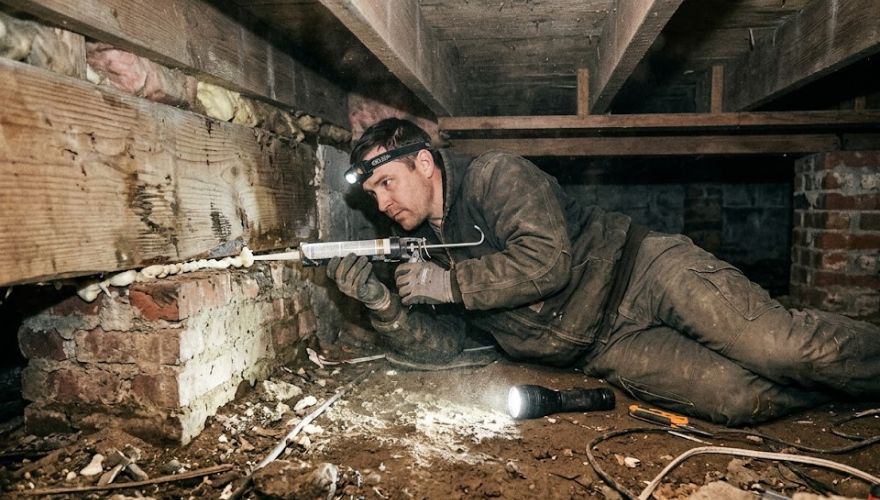
 Ground-level entry control
Crawl Space Entry -- The Norway Rat's Primary Pathway in Huntsville
Older Huntsville housing -- the pier-and-beam construction common in Merrimack, Terry Heights, Lincoln Village, and older sections of South Huntsville -- sits on crawl spaces that provide ideal Norway rat habitat. The protected soil, moderate year-round temperatures, and structural timber provide nesting sites. The crawl space is a destination, not just a transit zone.
From the crawl space, Norway rats access the living space above through floor penetrations -- gaps around plumbing drain pipes, floor joist ends, HVAC penetrations in the floor, and through damaged floor decking. Sealing the crawl space perimeter at foundation level is the critical step that prevents this ground-to-interior pathway. House mice use the same entry points but can access even smaller gaps: open weep holes, hairline foundation cracks, and deteriorated foam sealant around pipe penetrations.
Crawl Space Entry Points We Seal
Crawl space vents
Original ventilation screens in older Huntsville homes are often large openings with deteriorated metal screening, easily accessed by Norway rats. We install hardware cloth (quarter-inch galvanized or stainless) over or in place of deteriorated screens.
Access doors
Crawl space access hatches often have gaps at corners, hinges, or where the door has settled and no longer seals flush. Gaps of a half inch or larger allow rat entry; smaller gaps allow mice.
Utility penetrations
Plumbing, electrical conduit, and HVAC lines entering through the foundation or sill plate are sealed with appropriate materials -- expanding foam with hardware cloth insert, or mortar for larger openings.
Foundation voids
Masonry foundations in older Huntsville homes develop voids as mortar deteriorates and blocks settle. Larger voids at grade allow Norway rat entry and are filled with hydraulic mortar appropriate for below-grade applications.
Sill plate gaps
Where wood sill plate meets the foundation wall, gaps develop from wood shrinkage and foundation settling -- a consistent mouse entry zone in Huntsville pier-and-beam housing.
Plumbing drain exits
Where drain pipes exit through the foundation for sewer or septic connection, the pipe-to-foundation junction is often unsealed -- a direct Norway rat pathway in older construction.
Sealing Materials for Crawl Space Work
Crawl space sealing uses materials appropriate for sub-grade, high-moisture environments: galvanized or stainless hardware cloth for corrosion resistance, hydraulic cement for below-grade masonry voids, and expanding foam with mesh backing for utility penetrations. All materials are selected for durability in Huntsville's humid climate rather than for indoor applications.
Frequently Asked Questions
Do I need to clear my crawl space before sealing?
No. We work in occupied crawl spaces with appropriate safety equipment and work within existing conditions.
Can rats get through crawl space vents even with screening?
Yes, if screening is deteriorated, has holes, or is the wrong mesh size. Original metal screens in older Huntsville homes often have gaps from rust or corrosion. We replace or overlay with quarter-inch hardware cloth that resists Norway rat gnawing.
Is crawl space moisture related to rodent activity?
High-moisture crawl spaces support insect populations that attract Norway rats as supplemental food and provide favorable nesting conditions. We note moisture conditions during inspection and can recommend an encapsulation contractor if moisture management is also needed.
How long does crawl space sealing take?
Typical jobs take 2-4 hours depending on linear footage of foundation perimeter, number of vents and penetrations, and access difficulty. We quote time and scope after the inspection.
Do you seal from inside or outside the crawl space?
Both, depending on the entry type. Exterior vent screens are typically serviced from outside. Interior foundation gaps and pipe penetrations are addressed from within the crawl space. Our technicians carry appropriate PPE for confined space access.