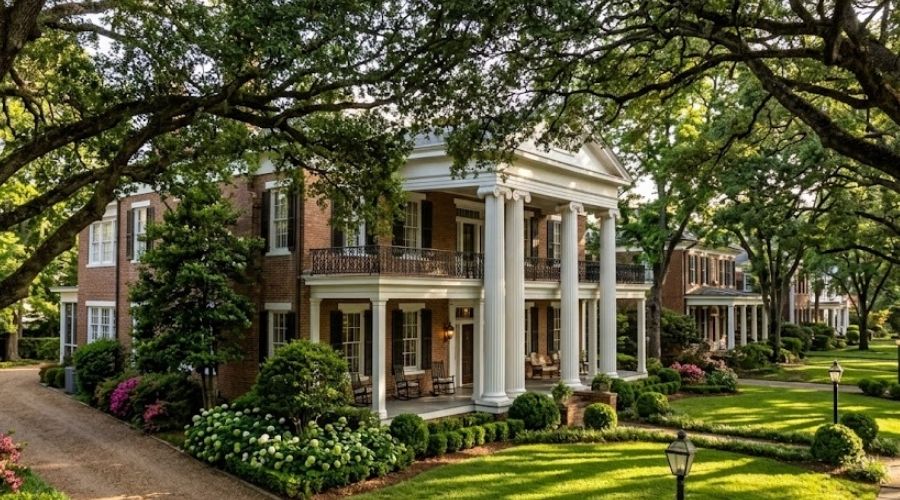
Twickenham Historic District encompasses more than 70 structures predating 1900, concentrated in the blocks immediately northeast of downtown Huntsville between Williams Avenue and the Tennessee River floodplain. It's the oldest intact antebellum district in Alabama, and from a rodent control standpoint, it's the most challenging residential environment in Huntsville.
The challenge isn't just the age of the construction — it's the combination of factors that reinforce each other. Century-old building systems with extensive settled gaps. Mature hardwood canopy that has been developing since before the Civil War. Proximity to downtown sewer infrastructure. And preservation obligations that limit what can be done to the exterior of structures within the district without violating the historic character of the neighborhood.
The Construction Era Problem
A Twickenham home from the 1880s has experienced 140 years of expansion and contraction through Alabama's temperature cycles, settlement of the underlying soils, weathering of original wood framing, and the accumulated effect of maintenance that was done — and not done — across a dozen ownership transitions. The result is a building with many more significant gaps than an equivalent-sized modern home.
The original pier-and-beam foundations that underlie most Twickenham structures have developed settlement gaps at sill plates and foundation piers that weren't present at original construction. Original crawl space ventilation screens — installed when the homes were built in the late 1800s and early 1900s — have corroded to the point of open access on many properties. Original wood soffit and fascia systems have separated at joints and buckled from moisture cycling.
Each of these conditions represents a rodent entry point. A typical Twickenham property inspection finds significantly more entry points than a comparable modern home — not because the owners have neglected maintenance, but because 140 years of physics has inevitably opened gaps that weren't there originally.
The Canopy Problem
Twickenham's hardwood canopy has been developing for generations. The oaks, magnolias, and sycamores in the district are among the largest and oldest urban trees in Huntsville, with spreading crowns that in many cases completely overhang residential rooflines from multiple sides simultaneously. This canopy delivers roof rats to rooflines from multiple approach vectors — not just one overhanging branch that can be trimmed, but a continuous canopy that surrounds the property.
Monte Sano State Park, while several miles from the Twickenham district, maintains a wild roof rat population that uses the continuous urban canopy as a dispersal corridor into the city's historic neighborhoods. Twickenham's proximity to the Big Spring Park tree coverage and the wooded corridors along the Aldridge Creek drainage amplify this dispersal pressure.
The Preservation Constraint
Properties within Huntsville's historic district designations are subject to design review for exterior modifications. Rodent exclusion work that would visibly alter the character of original architectural fabric — drilling through original brick, replacing original wood soffit panels with modern materials, applying sealant that discolors historic masonry — may require approval or be prohibited entirely.
Effective rodent exclusion on Twickenham properties uses materials and methods matched to historic surfaces:
- Copper mesh for brick weep holes — doesn't corrode or stain the surrounding brick, maintains the drainage function of the weep hole, and is nearly invisible at ground level
- Lime mortar-compatible sealants for gaps in historic masonry — standard Portland cement-based caulk is incompatible with lime mortar and can trap moisture in ways that damage historic brick
- Hardware cloth attachment at soffit gaps using methods that don't damage original wood surfaces — staple-and-caulk methods on the interior face of a gap rather than through the original wood face
- Stainless steel mesh at roofline gaps where durability and corrosion resistance are needed without visible alteration of the roofline character
Work that would require drilling through original brick, replacing original architectural elements, or applying treatments that alter the visual character of the structure is always discussed with the property owner before proceeding. We don't make decisions about historic fabric unilaterally.
The Twickenham species mix
Twickenham properties typically face roof rats in the attic (delivered by the overhead canopy), Norway rats in the crawl space (entering through deteriorated foundation vent screens), and house mice throughout (entering through brick weep holes, sill plate gaps, and utility penetrations). Mixed-species infestations requiring parallel treatment programs are more common in Twickenham than in any other Huntsville neighborhood.
What Effective Twickenham Rodent Control Looks Like
The inspection process on a Twickenham property takes longer than on a modern home — there are more spaces to access and more potential entry points to document. We inspect the attic (roof rat evidence — droppings on rafters, grease smears on beams, nesting material in insulation), the crawl space (Norway rat evidence — droppings, nesting material, burrowing), all interior living spaces (house mouse evidence — droppings in kitchen and pantry, gnaw marks), and the complete exterior perimeter (entry point mapping).
Treatment runs in parallel for all identified species. Roof rat removal uses attic trap placement along confirmed overhead runways. Norway rat removal uses ground-level placement in the crawl space and along confirmed floor-level runways. House mouse removal uses comprehensive perimeter snap trap placement.
Exclusion follows removal completion, using the heritage-compatible materials and methods described above. A complete Twickenham exclusion job often takes longer than a modern-construction job of equivalent square footage because the number and variety of entry points is greater.
The result, when done correctly, is a Twickenham property that holds. The entry points are sealed, the active populations are eliminated, and the combination of those two outcomes produces a result that doesn't reverse within a season — even given the relentless canopy pressure and the surrounding Norway rat population in the downtown drainage infrastructure.
Own a Historic Twickenham Home?
Heritage-sensitive rodent control for Huntsville's historic district. Free inspection, Mon-Sat 7AM-10PM.
📞 Call (844) 635-0403